Happy birth anniversary to...
"...the artist who said, “I would like to paint the way a bird sings” - Claude Monet, born in Paris in 1840. His father ran a grocery store and had hoped that his son would follow in his footsteps. The boy had other ideas and vowed to become an artist, much to his father’s dismay. Monet began his studies at the age of 10 in Le Havre, working first in charcoal. He drew caricatures, which he would sell to the locals for 10 or 20 francs apiece. About five years later, he befriended artist Eugène Boudin, who became his mentor and taught him oil painting. Boudin also encouraged him to paint en plein air [in the open air], or outside. “One day, Boudin said to me, ‘Learn to draw well and appreciate the sea, the light, the blue sky,’” Monet later said. “I took his advice.”
In 1861, he joined the cavalry in Algeria, intending to serve for seven years. Two years later, he contracted typhoid, and his aunt arranged for him to be discharged; he returned to France to study art, rejecting the traditional École des Beaux-Arts in favor of the private Académie Suisse. It was there that Monet met Pierre-Auguste Renoir, Alfred Sisley, and Frédéric Bazille; the four young artists became disillusioned with the meticulous detail that was fashionable in academic circles, and they began experimenting with a new style of landscape painting, producing rapid “sketches” using short, broken brushstrokes and trying to capture, above all, the fleeting quality of the light. Monet produced many paintings in the late 1860s, and although he hadn’t fully adopted the technique that he became known for, he did break from tradition by painting scenes from everyday, middle-class life. He received positive notice for his painting The Woman in the Green Dress in 1866; his model, Camille Doncieux, became his lover and, later, his wife.
His painting Impression, Sunrise, which he painted in 1872, was exhibited for the first time at an independent art show in 1874, and it was his first public showing of the sketch-like style he had been trying out. “I had sent a thing done in Le Havre, from my window, sun in the mist and a few masts of boats sticking up in the foreground,” he later wrote. “They asked me for a title for the catalog, it couldn’t really be taken for a view of Le Havre, and I said: ‘Put Impression.’” The painting and the show were poorly received by the critics, including Louis Leroy, who dubbed the style “Impressionism.” Leroy was being derogatory, and wrote, “Wallpaper in its embryonic state is more finished than that seascape,” but Monet and his contemporaries adopted the name anyway. For his part, Monet felt he had finally come home. “I didn’t become an impressionist. As long as I can remember I have always been one.”
Camille died of tuberculosis in 1879, shortly after the birth of their second son. Monet painted a portrait of her on her deathbed, as a last tribute. He told his friend Georges Clemenceau: “Color is my daylong obsession, joy, and torment. To such an extent indeed that one day, finding myself at the deathbed of a woman who had been and still was very dear to me, I caught myself in the act of focusing on her temples and automatically analyzing the succession of appropriately graded colors which death was imposing on her motionless face.” He grieved her loss deeply, for several months, but felt a renewed passion for his art, and moved with his children to the home of his patron, Ernest Hoshedé. The patronage fell apart when Hoshedé ran into financial difficulties, but Hoshedé’s wife Alice provided patronage of a different sort; they began an affair, she paid Monet’s debts with her dowry, and eventually moved with him to Giverny, where the artist bought a small farmhouse surrounded by an orchard. They eventually married after the death of her husband in 1892; the following year, Monet bought a strip of marshland across the road from his house, and found great pleasure in designing a water-garden. “I am only good at two things, and those are: gardening and painting,” he wrote. He spent nearly 30 years in his gardens, planting and painting irises and tulips, wisteria and bamboo.
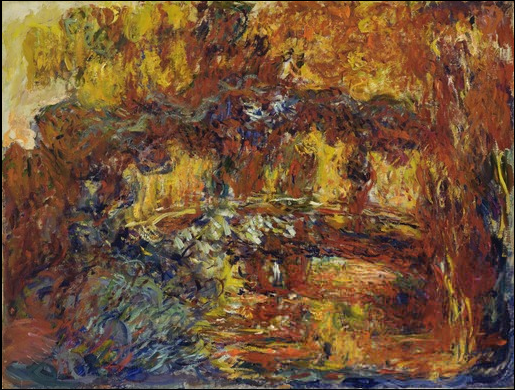
Later in his career, he became interested in painting the same subject at different times of day, and produced several series: water lilies, haystacks, poplars, the cathedral in Rouen, and the Houses of Parliament in London. As he grew older, he developed cataracts, which left him nearly blind and had a profound effect on his perception of colors. His tones became muddy and muted, and his paintings had a reddish or yellowish cast. He had to rely on the labels of his paint tubes to tell him what color they contained, but he was determined to carry on. In 1921, he told a journalist, “I will paint almost blind, as Beethoven composed completely deaf.” In a letter to a friend in 1922, he complained: “To think I was getting on so well, more absorbed than I’ve ever been and expecting to achieve something, but I was forced to change my tune and give up a lot of promising beginnings and abandon the rest; and on top of that, my poor eyesight makes me see everything in a complete fog. It’s very beautiful all the same and it’s this which I’d love to have been able to convey. All in all, I am very unhappy.” He finally agreed to have surgery performed on his right eye in 1923, but he was disappointed with the results and refused to have the procedure repeated on his left eye. He was never again able to use both eyes together effectively, and was only able to read and
write with the aid of special glasses. He died of lung cancer in 1926; his home and gardens in Giverny are now the property of the French Academy of Fine Arts, and host visitors from all over the world.
Writer's Almanac 2017
He said, "I perhaps owe having become a painter to flowers."


%20view%20from%20the%20Louvre%20window.jpg)