Copyright and other blogs currently being worked

ALCHEMY OF CLAY: Art and life connect! This fabric design is by Amanda Richardson - British fabric & textile artist in Penberth Valley, Land's End, Cornwall, England, UK

My info

Showing posts with label North Carolina. Show all posts

Sunday, May 19, 2019

These mountains I love


a bit of haze that gradually cleared, giving us sunburns which we gladly welcomed in early spring.


 The motel part of the Pisgah Inn
 looking toward the restaurant and gift shop
my favorite easily identified wildflowers!

Tuesday, September 11, 2018

A (very brief) History of clay in North Carolina

Seagrove is known for being the pottery center of North Carolina...and there are definitely more potters per square mile than any other location.

One result is the North Carolina Pottery Center, a museum and educational center.

The educational portion of the museum looks to some of the history of clay as a form of functional and artistic pottery.

And how did young people who were drawn to the craft learn about the skills?  Here is a 1970 photo of Penland School of Crafts students watching a demonstration by teacher,  Cynthia Bringle, who is still making beautiful pottery and has her studio at Penland in 2018.


Penland School of Crafts is closer to Black Mountain, being in the mountainous area of North Carolina.  It has a great gallery, open house, auction and studios...with classes in many crafts! Check out their own site.  I've posted several blogs about my visits there, (HERE) and (here)

Many potters today learn on a kick-wheel.  Before electric wheels, pretty much all pottery was thrown this way.

An interesting framing of a photo of clay diggers...as if we're looking through a window.  Clay is found along many creek banks in North Carolina, and some potters still dig their own clay, but most of it is processed in big warehouses so there's consistency in its handling and firing.

A great little diorama of a man firing a wood burning kiln...a bee-hive shape.  Now there are gas and electric kilns, but the beauty of wood firing is apparent and used by many potters still today.

A long shed roof protects the wood firing kiln, where the fire box is at one end, and many pots are loaded in the middle, before the heat escapes the tall chimney at the other end (missing in this model.) The grey pot shown is not part of the kiln model.

A kitchen scene shows how many types of pottery were used in early America.


And just in...from a post on Facebook for Spruce-Pine Potters Market!

What is a pot
a pot is not
just any gray
little bowl of clay
a pot is a pot
for daffodils
or a porridge pot
or a pot for pills
cruets and goblets
jars and jugs
platters and plates
and trays and mugs
shallow pots
or dark and deep
pot to give
and pots to keep
touch them, hold them
pick them up
batter bowl
or saké cup
and feel the curve
of earth and sky
kitchen warm
or springtime shy
a pot is mood
of many hues
but most of all
a pot is to use.

Delighted to welcome @cynthiabringle back to SPPM! She is one of our Esteemed Elders and is also the Mayor of Penland (😉). 

Saturday, October 28, 2017

Henry Rogers and Elijah Rogers, petitioners

A few weeks ago I shared to a Facebook group, my thrill at seeing Henry Rogers' signature, along with Elijah's on a petition in 1788.  (The Facebook closed group is Sevier County Tennessee Genealogy Active Sharing.)

That was in the area that was then part of North Carolina, before Tennessee became a state.  The area was only identified as South of the French Broad River.  But other information states it was in Franklin, a proposed state that never became a reality, which was proposed because North Carolina didn't offer any protection to the settlers from the Indians...which was the purpose of the petition to the legislature of the young state of North Carolina.  It also asked the NC legislature to consider making a new county in this large area.  The several petitions apparently said much the same thing over 1788-1789.


Far right hand column, Henry Rogers is listed, with Elijah Rogers 6 below.  But the corker for me was seeing the microfilm of the actual signatures.

Henry and Elijah Rogers signed (or had scribe sign) petition 1788 Franklin NC
Someone mentioned in a comment that the photocopy indicated some of the signatures had probably been signed by the scribe who wrote the rest of the petition.  But interestingly enough, Henry Rogers and Elijah look to be signed in another hand.

FYI, Franklin wanted to be a separate state, in case you don't remember that part of history following the first 13 which became states after the American Revolution.  It had a constitution and governor, and lasted about 4-1/2 years, not being acknowledged by the Congress of the United States after many petitions for statehood.  see:https://en.wikipedia.org/wiki/State_of_Franklin

Background: basically North Carolina decided first in April 1784 to give the lands west of the Appalachian mountains (as far as the Mississippi) to the new United States to pay their share of the war debt.  Then a few months later, they changed their minds and it was still North Carolina territory, and supposedly receiving soldiers and judges in the frontier where new communities formed.

In the meantime, the settlers in that area (probably including the Rogers) were having Indian difficulties, based on all the different tribes making different treaties at different times.  


By August 1784 the new state of Franklin was formed.  But the constitution it originally offered to the inhabitants excluded lawyers, doctors, and preachers as candidates for election to the legislature.  It wasn't approved, so the laws of North Carolina continued until a new Franklin government and constitution came about in 1785, while the state of North Carolina had a rival county government in the same area.  Come tax season this must have been a quandary for the inhabitants.  Apparently Franklin government was willing to accept barter for payments due, and gave its citizens a 2 year reprieve of paying property taxes.

Native Americans (called Indians in almost all historic documents) had claim still to much of the land that whites were settling on, and the governments (new United States) and North Carolina, were making different treaties with different tribes.  Confusion and discord reigned with violence erupting frequently.  

The last meeting of the state of Franklin legislature was in September 1787.  The state of NC was threatening the state of Franklin governor (John Sevier) and insisted he pay his back taxes, and in Feb 1788 seized some of his property, including a slave.  There was an attempt by Franklin citizens to obtain him back, but the militia of NC fought them off, and several men died.  By Feb. 1789 Seivier gave his allegiance to the state of North Carolina, and the state of Franklin was no more.
"After the dissolution of the State of Franklin in February 1789, continued support of the separate state movement was confined largely to Sevier County, specifically in the country south of the French Broad River. The people there realized that the only entity recognizing title to their land holdings had been Franklin.  Both North Carolina and the Federal (Confederation) government supported the Cherokee claims as set forth in the Treaty of Hopewell, and considered settlers in the area "squatters". This led to the formation of a "Lesser Franklin" government, with an Articles of Association similar to the earlier Watauga Constitution. In 1789 these Articles were adopted at Newell's Station, which served as the seat of government for the wider area of Lesser Franklin, including all the settled country south of the French Broad.[9]
"The Lesser Franklin government finally ended in 1791, when Governor William Blount, of the newly formed Southwest Territory, met the Cherokee chieftains on the site of the future Knoxville, and they made the Treaty of Holston. The Overhill Cherokee now acknowledged the authority of the United States government, and ceded to the Federal government all of their lands south of the French Broad, almost as far as the Little Tennessee River.[9] 
Source of quotes from Wikipedia above: Sevier County Settlers vs. the Cherokee Indians; Tennessee Genealogy web online; accessed March 2014. 

The Henry Rogers and Elijah Rogers families were living in future Sevier County.  They were asking North Carolina for assistance, though also probably hoping the Lesser Franklin government would also help them.  If they were considered citizens of North Carolina, they wanted its protection from Indians.


The State of Franklin (in red) superimposed on a map of modern Tennessee
Note: Sevier County is east of Knoxville.  


Severe County, Tennessee
I'm adding this to Sepia Saturday this week...who had a prompt like this (and I haven't anything along those lines at all!)

Sorry about that, fellow Sepians... the ancestors signed on to have me feature them this week.  After all, Halloween is noted as the time when the veils between the living and those who have gone before (ancestors etc.) are thinest.  I also appologize for all the strange colors of type.  Computers seem to be haunting me also.

Today's quote:


The same pain that can blemish our personality can act as a creative force, burnishing it into an object of delight.
PIR VILAYAT INAYAT KHAN


Saturday, September 8, 2012

Coming Home


So here's the important part of coming home.

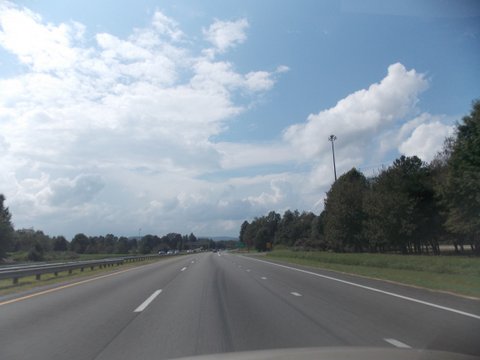
It's hard to tell that this picture is in one part of the state or another, but for me it's the first glimpse of a mountain straight ahead.

Whow...look at those clouds over the pass.  Will I get smacked with another rain storm?  (I exited the highway at a Mt. Airy exit earlier, and got turned around getting onto I-40 west.  It just felt like I was going east for the first 5 miles)
Not a bad shower, but left windshield a bit wet as I went slowly around the switchbacks of Swannanoa Gap.  Notice I'm driving over in the truck climbing lane...and there wasn't a single semi on it!
I hope Linda Starr sees the highway right here in Black Mountain that has the Blue Star title...in honor of American Ex-Prisoners of War.  I dare say half the people that live here have no idea that's the name bestowed upon our "State Street" or Hwy 70 as it comes into town.

 
I turn past the primary school on Richardson and love the yellow flowers and yellow busses together, seen through the reflections in my car windshield.


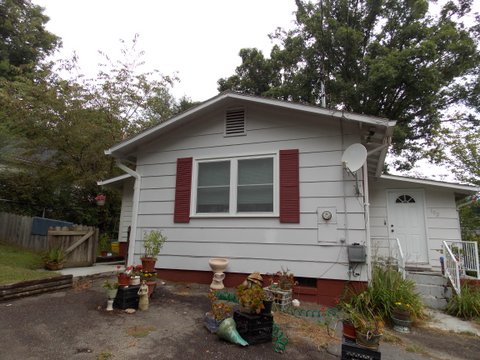
And I'm so happy to see my little cottage is sitting here waiting for me, and my friend Tim has mowed while I was away.  What a sweet feeling!  Home sweet...you know.