Copyright and other blogs currently being worked

ALCHEMY OF CLAY: Art and life connect! This fabric design is by Amanda Richardson - British fabric & textile artist in Penberth Valley, Land's End, Cornwall, England, UK

My info

Showing posts with label archaeology. Show all posts

Tuesday, September 17, 2024

Archaeology of today

 History goes deep.


Mesa Verde is well known for the many Ancestral Pueblo sites that cover the landscape, where farmers made their homes from 500 AD to 1300 AD. But there is also evidence for the pre-agricultural history on the land, such as this knapped stone point found in the backcountry. This artifact is most consistent with Hell Gap-type points, which typically date from 10,900 to 12,300 years ago!

In fact, discoveries at White Sands National Park indicate that people have been living in what is now the American Southwest for at least 20,000 years! These pieces of evidence are rarer due to the passage of time, but physical evidence increasingly shows that people are an integral part of these lands.

Commenter Dann Russell said:
Looks more like a Haskett due to the rounded base, whereas Hellgap are squared off.


Image credit: NPS/ Logan Dean

National Park Service?
SOURCE: Mesa Verde National Park Facebook page.

This and many other finds have shown that humans were in the Americas way before the Bering Strait land bridge theory which has long been taught by archaeologists as how first humans arrived.


Mesa Verde National Park in Colorado offers a unique window into the lives of the Ancestral Puebloans, a people who built and thrived in this region over 700 years ago. Established as a national park in 1906, Mesa Verde preserves some of the best-preserved cliff dwellings in North America, making it a place where history, archaeology, and stunning landscapes converge.

As you explore the park, you'll discover the incredible architecture of the cliff dwellings, which are nestled into the sides of steep sandstone cliffs. The most famous of these is Cliff Palace, the largest cliff dwelling in North America, with over 150 rooms and 23 kivas (ceremonial rooms). Walking through these ancient structures, you can almost feel the presence of the people who once called this place home, as you imagine what daily life was like in this rugged yet beautiful environment.

Beyond the cliff dwellings, Mesa Verde offers a landscape of rolling mesas, deep canyons, and panoramic views of the surrounding region. The park’s diverse terrain supports a wide variety of plant and animal life, adding another layer of richness to the experience. Hiking trails such as the Petroglyph Point Trail or the Soda Canyon Overlook offer opportunities to explore the park’s natural beauty while also encountering ancient rock carvings and more secluded ruins.

Visiting Mesa Verde is not just a journey into the past; it's also a chance to connect with a landscape that has been home to humans for thousands of years. The park stands as a testament to the ingenuity and resilience of the Ancestral Puebloans and offers a profound reminder of the deep history that shapes the American Southwest. SOURCE: Mesa Verde National Park Facebook page.


Today's quote:

I held a blue flower in my hand, probably a wild aster, wondering what its name was, and then thought that human names for natural things are superfluous. Nature herself does not name them. The important thing is to know this flower, look at its color until the blends become as real as a keynote of music. Look at the exquisite yellow flowerets at the center; become very small with them. Be the flower, be the trees, the blowing grasses. Fly with the birds, jump with a squirrel!
- Sally Carrighar, Home to the Wilderness  

Monday, November 4, 2019

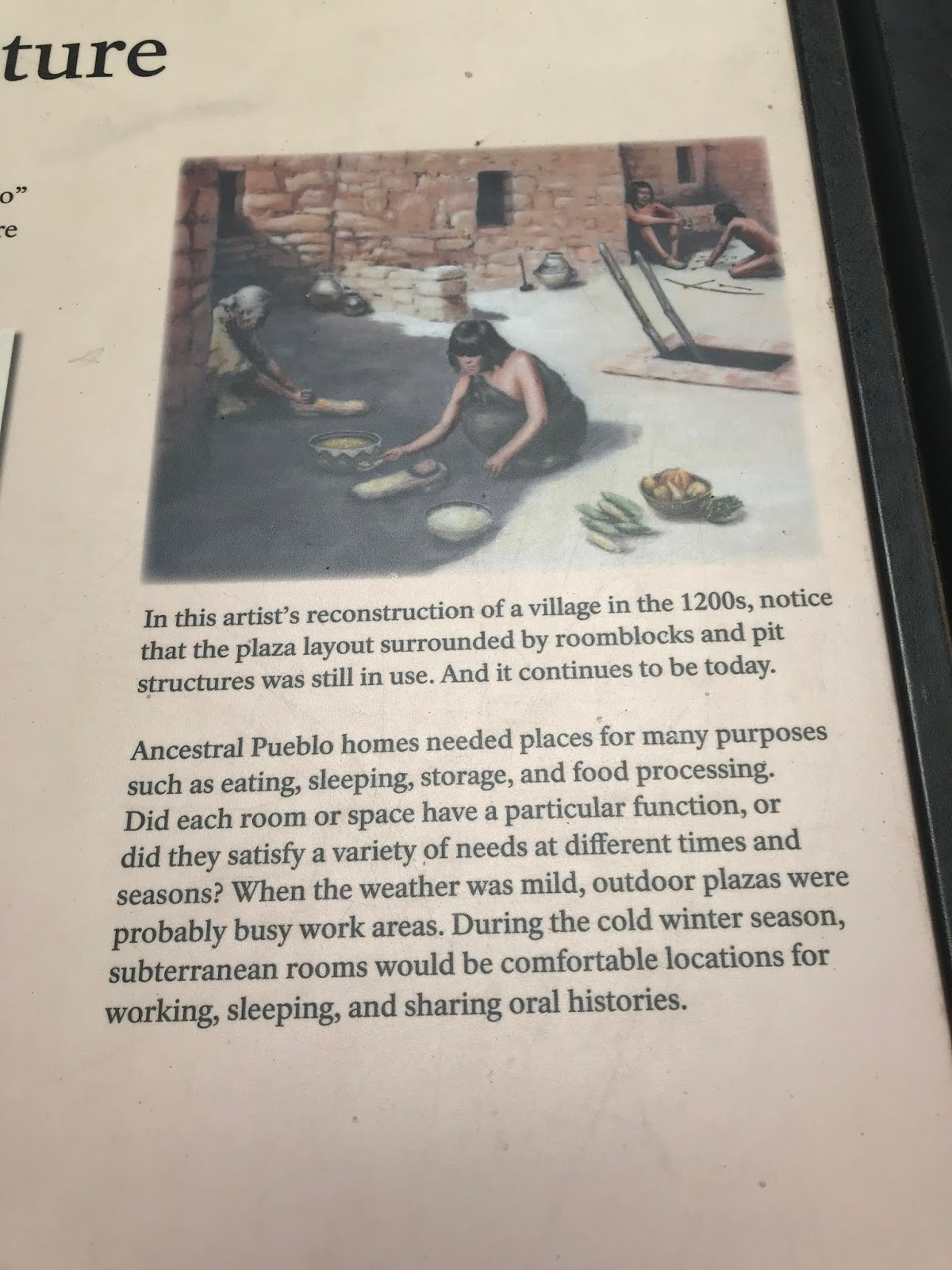
Some archaeology at Mesa Verde - not cliff dwellings

I will be showing lots of photos of the cliff dwellings over on "When I was 69"


Looking to right of the exhibit (explained below)
Looking to left (see explanation of what these buildings were in second panel with layout explained below)


 I think my photos got downloaded out of order...for this shelter building is just a roof, while the other one has metal sides.  I am not sure which parts now belong to which descriptions.


Saturday, January 13, 2018

Clay art and archaeology


And this is the oldest ceramic object (so far) in the world, she was made between 27,000 and 29,000 years ago, at what is now Dolni Vestonice in what is now the Czech Republic.  The good news is that it hasn't been called "A VENUS" statue, which refers to much later goddesses. 

And just to be balancing of the nude sexes (which art seldom does)...


I don't know the source of this Pan, Nature god complete with phallus.  And I am only guessing that he was made of clay.  Lots of repair work, so he could be stone. And he definitely would belong to the civilizations that rose around Greek/Roman times.  Please comment if you know who he is...where he was found, I mean.

And speaking of cultures, have you seen this incredible video of the history of the world populations?
Give yourself time to enjoy this, and stop and pause it when it gets really interesting.

The History of the World, Every Year

--------------------------------------------------------------
Today's quote:


"You carry Mother Earth within you. She is not outside of you. Mother Earth is not just your environment. In that insight of inter-being, it is possible to have real communication with the Earth, which is the highest form of prayer." ~ Thich Nhat Hanh 


Friday, April 29, 2016

Art being protected

I think mainly of pottery when I think of art. That includes archaeology where ancient beauty has been immortalized in various forms.

Probably a jaguar jug

Maybe another kind of jaguar, a black one
A drumming bird
Some Moche (100-800 AD) stirrup-handled figurative pots from Mesoamerica. I saw these in a North Carolina museum a few years ago.


Ceramic sculptural tetrahedrons by Tai Rogers, my son, sitting in the crouch of the cherry tree.

From Florida art museum
Photo of a small ivory (2" I think)  prehistoric goddess figure, found in Germany in 2009.

Jomon jar, from Honshu, 2500-1500 BCE.

Thanks to Sepia Saturday for giving me a chance to troll through my own archives to find some of my favorites.  For more interesting stories about old art treasures, or other topics, link on over to their site

 
"...1914 photograph from the Flickr Commons collection of the Dutch National Archives. The caption of the photograph is "The Great War. Refugees from Antwerp, Belgium, bringing a painting into safety. Belgium, 1914"


Wednesday, May 13, 2015

Meandering thoughts

Good morning, or is it evening when you glance at my blog?
Just wondering.

The other evening some of us gathered to watch a relatively old video in the series "Goddess Remembered" (1989) created by Donna Read of Canadian Broadcasting.

This documentary is a salute to 35,000 years of the goddess-worshipping religions of the ancient past. The film features Merlin Stone, Carol Christ, Starhawk, Luisah Teish and Jean Bolen; all of whom link the loss of goddess-centric societies with today's environmental crisis. This is the first part of a 3-part series that includes The Burning Times and Full Circle.

I'll be happy to hostess a viewing of the 2 remaining films after summer solstice.
----------------------------

Now there's a movement called Eco-feminism.  As well as lots of other environmental groups with very positive momentum.  It's needed more than ever.


So what's with studying goddess cultures that existed so long ago, before the ones of today where we find the goddess in second place in a hierarchy of deities?  Name one religion today where goddesses are venerated either as primary or even equal to male deities.

They were egalitarian societies where women and men were equals.  Societies that lasted thousands of years without warfare.

How can archaeologists tell this?  They examined the ruins of cities without any defensive fortifications.  There are no weapons besides those used to hunt and prepare foods.  See Marija Gimbutus work for more information on this.

Just think.  Life without warfare at all.

Nobody who greets a stranger had to worry about evil intentions.  A time when Rumi's poems would truly mean you welcome all guests to your home, even without knowing who they are.


Imagine when the deities of these civilizations were female, as evident through thousands of figurines, carefully made and even placed in areas of the homes and cities suggesting rituals of some kind. There are very very few male oriented sculptures which were found.  This led the early male archaeologists who found all these female forms to think only of "fertility goddesses" and that ancient men perhaps had made them with the same intentions modern men have in looking at feminine beauty.


I'm thrilled about the concept that a culture where men and women had equality would mean that women would be equal to men...and men would be equal to women.  Nobody would be Top Dog.  Nobody would be Bottom Dog.

---------------------------------
It is so hard to express the concept of true equality across to a culture (today) where there is such hierarchical competition to be the winner, to prove something is better than something else, to elect only the one candidate, and then the 49% who lost don't have any representation.  We are submersed in a culture of inequality, and don't see it, just like the fish who has no concept of water until she's out of it.

-------------------------
Power "over" the earth is now the most important place where we need a new way of co-existing.  If we want to continue living on it, we need to recognize our symbiotic relationship with all life, the chemicals we create and discard, and how we can improve the earth rather than destroy it.

Today's Quote:


O Great Spirit, I awake to another sun, grateful for gifts bestowed, granted one by one.
Twylah Nitsch
Seneca Medicine Woman