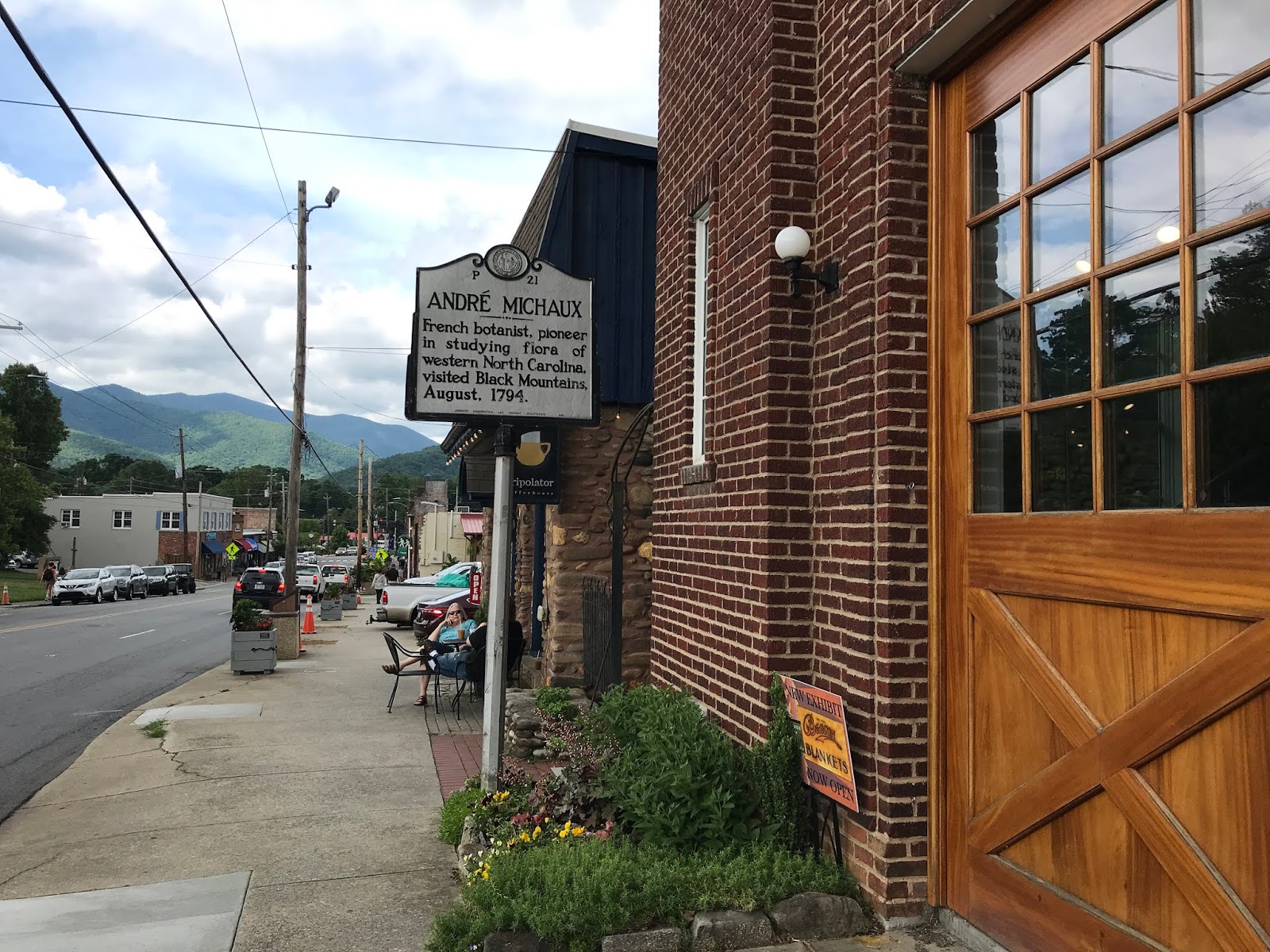
This is the new sign at theSwannanoa Valley Museum...in Black Mountain NC. It's really nice. The next entrance along the way is the Black Mountain Center for the Arts.
Just past the historic marker for French Botanist, Andre Michaux, people are lounging outside of the Dripolator coffee shop. This is looking east along State Street.
These large wood doors are replicas of the original fire house doors, which now houses the SV Museum. When it was the fire house, there was even the pole which fire fighters would slide down from the second level. (A sign designates where the pole and the hole in the ceiling used to be.)
Copyright and other blogs currently being worked
ALCHEMY OF CLAY: Art and life connect! This fabric design is by Amanda Richardson - British fabric & textile artist in Penberth Valley, Land's End, Cornwall, England, UK
My info
Showing posts with label Swannanoa Valley History Museum. Show all posts
Sunday, June 16, 2019
Tuesday, August 14, 2018
Cloth before the Industrial Revolution
Before the industrial use of mechanical looms, this was how our clothes were made. Yep. Look to the 1700s and cloth was very precious because of the many woman-hours it took to make - not to mention then to cut and sew into clothing.
A woman would sit here for many hours, and usually had a wider amount of threads across (I never can remember which is warp and which is woof.)
Last 2 pics are of a standing spinning wheel. It meant standing while feeding wool or other fibers onto it.
Handloom The Korkosz Croft in Czarna Góra, Poland, Nineteenth Century
Wikepedia shows the elements of a foot treadle floor loom...
I'll let you read what it says now...
Weaving is done by intersecting the longitudinal threads, the warp, i.e. "that which is thrown across",[2] with the transverse threads, the weft, i.e. "that which is woven".
The major components of the loom are the warp beam, heddles, harnesses or shafts (as few as two, four is common, sixteen not unheard of), shuttle, reed and takeup roll. In the loom, yarn processing includes shedding, picking, battening and taking-up operations. These are the principal motions.
Thanks for stopping by. And thanks to the Swannanoa History Museum of Black Mountain NC for the photo opportunity in their antique display.
Symbolism and Cultural Significance
The Loom is a symbol of cosmic creation and the structure upon which individual destiny is woven. This symbolism is encapsulated in the ancient Greek myth of Arachne who was changed into a spider by the goddess Athene,who was jealous of her skill at the godlike craft of weaving. In Maya Cultures the goddess Ixchel who is symbolized by the moon, taught the first woman how to weave at the beginning of time. (Source: Wikipedia)A woman would sit here for many hours, and usually had a wider amount of threads across (I never can remember which is warp and which is woof.)
Handloom The Korkosz Croft in Czarna Góra, Poland, Nineteenth Century
| Elements of a foot-treadle floor loom |
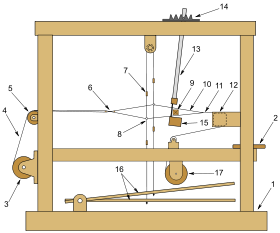
I'll let you read what it says now...
Weaving
See also: Weaving and Textile manufacturing terminology
The major components of the loom are the warp beam, heddles, harnesses or shafts (as few as two, four is common, sixteen not unheard of), shuttle, reed and takeup roll. In the loom, yarn processing includes shedding, picking, battening and taking-up operations. These are the principal motions.
- Shedding. Shedding is the raising of part of the warp yarn to form a shed (the vertical space between the raised and unraised warp yarns), through which the filling yarn, carried by the shuttle, can be inserted. On the modern loom, simple and intricate shedding operations are performed automatically by the heddle or heald frame, also known as a harness. This is a rectangular frame to which a series of wires, called heddles or healds, are attached. The yarns are passed through the eye holes of the heddles, which hang vertically from the harnesses. The weave pattern determines which harness controls which warp yarns, and the number of harnesses used depends on the complexity of the weave. Two common methods of controlling the heddles are dobbies and a Jacquard Head.
Shuttles
- Picking. As the harnesses raise the heddles or healds, which raise the warp yarns, the shed is created. The filling yarn is inserted through the shed by a small carrier device called a shuttle. The shuttle is normally pointed at each end to allow passage through the shed. In a traditional shuttle loom, the filling yarn is wound onto a quill, which in turn is mounted in the shuttle. The filling yarn emerges through a hole in the shuttle as it moves across the loom. A single crossing of the shuttle from one side of the loom to the other is known as a pick. As the shuttle moves back and forth across the shed, it weaves an edge, or selvage, on each side of the fabric to prevent the fabric from raveling.
- Battening. Between the heddles and the takeup roll, the warp threads pass through another frame called the reed (which resembles a comb). The portion of the fabric that has already been formed but not yet rolled up on the takeup roll is called the fell. After the shuttle moves across the loom laying down the fill yarn, the weaver uses the reed to press (or batten) each filling yarn against the fell. Conventional shuttle looms can operate at speeds of about 150 to 160 picks per minute.
Thanks for stopping by. And thanks to the Swannanoa History Museum of Black Mountain NC for the photo opportunity in their antique display.
Labels:
cloth,
spinning,
Swannanoa Valley History Museum,
textiles,
weaving
Thursday, August 9, 2018
The Swannanoa Valley History Museum
It's a sunny August day, but the vacation camps in Ridgecrest or Montreat give people Wed. afternoon free, so there are a lot of tourists in Black Mountain.
I arrive at 1:20 in time for my docent volunteer shift from 1:30-5:00 pm.
But can't just sit down. Talk with docent from this morning, talk with the director and meet the treasurer. Then visitors come in, and I welcome them...more than I expected, 2 groups of 3 at once. Then someone comes in to renew her family membership, and we get to talking.
A new book by our director, Anne Chesky Smith...I'm going to enjoy looking at the Then and Now photos of Black Mountain.
I arrive at 1:20 in time for my docent volunteer shift from 1:30-5:00 pm.
But can't just sit down. Talk with docent from this morning, talk with the director and meet the treasurer. Then visitors come in, and I welcome them...more than I expected, 2 groups of 3 at once. Then someone comes in to renew her family membership, and we get to talking.
A new book by our director, Anne Chesky Smith...I'm going to enjoy looking at the Then and Now photos of Black Mountain.
I love looking for various sites I've been to on the topographic map...that's the town of Black Mountain as the amorphous white area with a pin in it...and I live somewhere around Highway 70 looking toward High Windy Mountain in the foreground. (A visitor asked a good question, "Is there a real Black Mountain somewhere?"
"No not in these woods." I looked it up and one is in Maine, one in Vermont, and one in Kentucky.
Finally I walk about taking some outdoor photos. This is the first sunny day that I've volunteered here. However, within 2 hours, a summer afternoon thunderstorm hit! It was more trouble for the 12 people who were dropping in (most of them under 12 years old) and had to wait till someone went for their cars, then dashed out in the rain to get into cars that stopped in the main roadway.
The renovation 2 years ago meant putting replica doors in the style of the old fire house, which now houses the museum.
This is the entrance through which all visitors pass.
This is where I sit, behind the guest book.
Me being a docent in front of an old quilt depicting a historic Swannanoa Valley. (It's the only quilt here, sigh, made by Stephanie Wilds.)
Old jail cells that used to be in the basement of the then court house, which now is the Black Mountain Center for the Arts next door.
Upstairs are the old artifacts, a.k.a. antiques.
Downstairs is a temporary exhibit about Black Mountain College.
It includes a video...
And a faux geodesic dome...
But a picture of a real one (not at Black Mountain College, but someplace similar)
The first geodesic form was attempted to be constructed at Black Mountain College with Buckminster Fuller, but the material of venetian blind slats proved to be unsuitable. However the design was good, and the right materials have sure been built a lot since then.
My own post script from today's volunteering was that I now have permission from the director to use photographs the museum has in stock for sharing here on my blog! She even offered me digital ones scanned from originals. Whoo-hoo! What pleasure that will be to share with y'all.
"No not in these woods." I looked it up and one is in Maine, one in Vermont, and one in Kentucky.
Finally I walk about taking some outdoor photos. This is the first sunny day that I've volunteered here. However, within 2 hours, a summer afternoon thunderstorm hit! It was more trouble for the 12 people who were dropping in (most of them under 12 years old) and had to wait till someone went for their cars, then dashed out in the rain to get into cars that stopped in the main roadway.
The renovation 2 years ago meant putting replica doors in the style of the old fire house, which now houses the museum.
This is the entrance through which all visitors pass.
This is where I sit, behind the guest book.
Me being a docent in front of an old quilt depicting a historic Swannanoa Valley. (It's the only quilt here, sigh, made by Stephanie Wilds.)
Old jail cells that used to be in the basement of the then court house, which now is the Black Mountain Center for the Arts next door.
Upstairs are the old artifacts, a.k.a. antiques.
Downstairs is a temporary exhibit about Black Mountain College.
It includes a video...
And a faux geodesic dome...
But a picture of a real one (not at Black Mountain College, but someplace similar)
The first geodesic form was attempted to be constructed at Black Mountain College with Buckminster Fuller, but the material of venetian blind slats proved to be unsuitable. However the design was good, and the right materials have sure been built a lot since then.
My own post script from today's volunteering was that I now have permission from the director to use photographs the museum has in stock for sharing here on my blog! She even offered me digital ones scanned from originals. Whoo-hoo! What pleasure that will be to share with y'all.
Subscribe to:
Posts (Atom)